Push Not the River

Did you know Poland didn’t exist for 123 years? From 1795 to 1918, this Slavic nation literally disappeared from the map. With no regard for the people of Poland, eighteenth-century world superpowers Austria, Prussia, and Russia divided it among themselves.

Push Not the River, part one of James Conroyd Martin’s impressive Polish Trilogy, shines a spotlight on the tragic partitions that eliminated Poland for over a century. The novel centers on Anna Maria Berezowska, a young woman coming of age during the last two partitions of Poland in 1793 and 1795. I found the novel utterly fascinating. I’m not kidding when I say I couldn’t put it down.
Why did this novel capture me so? I felt a personal connection to it. My paternal grandparents emigrated from Austria to America in 1905. Even though their papers said they were from Austria, they weren’t Austrian; they were Polish people living in Galicia, a region occupied by Austria and Russia until 1918 in what is currently southeastern Poland and western Ukraine.
The capital of Galicia was Lwów, which today is Lviv in Ukraine. According to my father, my grandmother always pointed to Lviv on the map when asked where she came from. Grandma Nick, as we called her, had been born a Lis. My grandfather was a Cwikla, two entirely Polish surnames.
Beyond a few bits of family lore, the one including my grandmother telling her children she was born in Russia and at age five, crossed the River Vistula at night on her mother’s back to escape to Austria, we know extraordinarily little about what life was like for them in Galicia. The image below by a Polish painter reminds me of my grandmother fleeing with her mother. How I wish I knew more about her! But immigrants back then didn’t talk about “the old country,” and there were language barriers. My grandfather died in 1932, and my grandmother’s English was quite poor. She died in 1975. Questions about their past have haunted me for decades. What was their real story? Where were they born? What did their families do? What was life like for them?

Push Not the River doesn’t answer those questions, but it put me in touch with Poland’s history, which was their history. Even more interesting is that the novel is based on Anna Maria Berezowska’s actual diaries. Martin expands her story, using Poland’s painful demise as the backdrop. Reading it, I learned a great deal I’m ashamed to say I didn’t know.
The novel begins with a prologue. Anna Maria Berezowska is five years old and living on her family’s estate near Sochaczew, thirty miles west of Warsaw. It’s her name day, the feast day of the Christian saint associated with a person’s given first name. When Anna Maria chooses a small crystal dove as her special gift, she displeases her mother. But her father defends her choice, and the crystal dove shows up as a symbol throughout the novel, representing Anna Maria’s destiny and to follow her instincts.
Fast forward to chapter one. Anna Maria is seventeen. Her father has been murdered. Her mother dies in childbirth shortly afterward. Anna Maria is now an orphan. Because she is only seventeen, she is sent to live with her aunt and uncle in Galicia until she is eighteen. Anna Maria begins keeping a diary to record her life.
In Galicia, enter the Gronski family, which includes Anna Maria’s Aunt Stella, Uncle Leo, her cousin Zofia, and her cousin Walter, who is away fighting as a mercenary for Catherine of Russia. Much of Galicia has been under Austrian rule since the first partition of Poland in 1772. But the people, their language, food, customs, and social hierarchy, are still very much Polish.
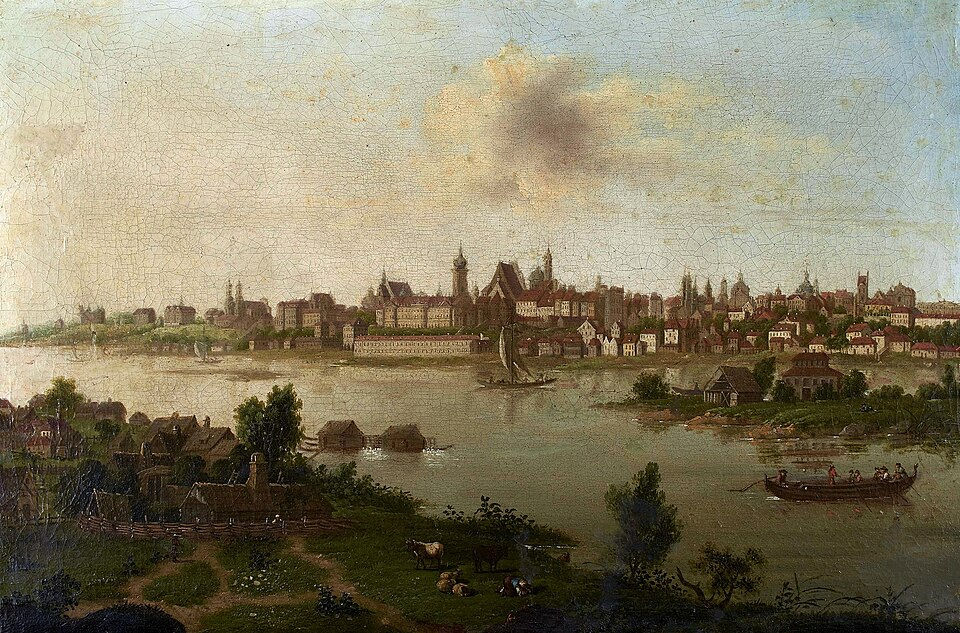
Enter next, Count Jan Stelnicki, the love interest. Anna Maria meets him by chance in a meadow. He’s young. He’s dashing. She’s smitten. So is Zofia, laying the foundation for a lifelong rivalry between the two cousins who are as different as night and day. Anna Maria is soft-spoken and reserved; Zofia is brash and, well, not a nice person. A terrible thing happens to Anna Maria that changes the course of her life forever. No spoilers here; you’ll have to read the book to find out what happens to her. You’ll be glad you did. Below is a painting of Warsaw as seen from Praga. Warsaw and Praga are important settings in the novel.
From a plot standpoint, Push Not the River sounds like a fairytale, right? Keep in mind that the events Martin writes about really happened. I know because I have a copy of Anna Maria’s diary. A descendant of hers, Jan Stelnicki, not to be confused with the character Jan in the novel, found it in his grandparent’s attic in Florida in the 1950s and later published The Diary of Countess Anna Maria Berezowska.
In the novel, the tragic story of Poland unfolds alongside Anna Maria’s between 1791 and 1794, making it a gripping tale of love, family, and survival during tumultuous political upheaval. I’m tempted to go into the political events that give Push Not the River its rich texture, but I won’t. Martin does it for us, beautifully blending history with storytelling by attaching important dates, historical figures, and events to his characters.
The political events in the novel include the second and third partitions of Poland when Prussia, Russia, and Austria divided what had been the Polish-Lithuanian Commonwealth in 1793 and 1795. (The first partition occurred in 1772.)

Admittedly, there are a lot of layers in Push Not the River. But it’s not like reading War and Peace, where the names and titles alone can overwhelm a reader. Instead, readers liken Push Not the River to novels like Gone with the Wind and Doctor Zhivago, an apt comparison.
Poland’s is a sad story, and at times, so is Anna Maria Berezowska’s. Here again, Martin is skilled in combining heart-felt human elements with factual elements. Given how much history is incorporated into the novel, the narrative moves surprisingly quickly. The plot is action-packed, making it a page-turner. I especially appreciated how Martin celebrates Poland as the setting for the novel, portraying the countryside, towns, cities, and homes in vivid detail, all while avoiding bogging down the narrative.

Anna Maria’s diary ended in 1794, but Martin wrote two more books in his Polish Trilogy. Books two and three carry Anna Maria’s story forward through her children. The novels are purely fictional since Anna’s diary ended and no further information is available about her. Not even a photo of her exists.
I had the pleasure of connecting with James Conroy Martin. After reading Push Not the River, I had so many questions. So I reached out to him, and he responded to my questions in writing.
NJM: I understand John Stelnicki approached you directly about writing Countess Anna Maria Berezoswka’s story. Is that correct? What made you decide to write it as fiction?
JCM: John knew I had come to California to study screenwriting, and he suggested I read the diary of his ancestor, a countess who started her journal in 1791. I read it, initially, out of politeness, but its story fully captured me. We thought it would be a non-fiction book, but as I worked with it, so much was missing, especially the history of the times, because Anna wrote as if only her contemporaries would be reading it. Also, people came into the story but seemed to be in need of a way to move off the stage. Despite the writing’s sense of genuineness and immediacy, some of the writing, like metaphors, were less than professional. So, in the end, I saw the only way forward was to take the liberties that fiction allows.
NJM: How much of Anna Maria’s diary do you believe is true? How would one verify its authenticity? She seems otherwise untraceable.
JCM: I believed in the story’s veracity because it was passed down in the Stelnicki family for generations. John knew that at some point it was somehow encased in wax for secrecy because there were certain passages of a sexual nature that were considered sinful. And yet, the family knew it was a historical document and dared not destroy it. Indeed, the historical events Anna chronicled proved verifiable. Everything in it that might stretch a reader’s credulity was already there. I was lucky enough to have the gift of a ready-made outline.
NJM: The novel is a compelling plot-twister. I couldn’t put it down. Where did you give yourself permission to embellish Anna Maria’s story to make it work as fiction versus someone simply reading her diary?
JCM: Once I chose the fiction route, I relied on Anna, who had provided the skeletal structure of all the key scenes. I merely had to color those in. Any embellishment came in adding the history, creating the in-between scenes, and in imagining the inner life of her mercurial cousin Zofia. Think Scarlett and Melanie. By the way, I saw the parallel to Gone with the Wind early on. And when Saint Martin’s Press brought it out, the very first blurb about it likened it to Doctor Zhivago and Gone with the Wind.
NJM: I can’t imagine the research required to write your trilogy. Besides Anna Maria’s diary, what were your main sources for capturing the historical and cultural details you included?
JCM: In the days before the internet, I bought books and borrowed from the library. I familiarized myself with Polish clubs, museums, and Polish writers who were welcoming and very helpful. (James Michener’s Poland was no help because the author skipped the 123 years during which Poland was missing from the map of Europe.) Shortly before completion of the project, I made a trip to Poland to get a true feel for the location. The first thing I did was to walk across the Vistula bridge from the suburb of Praga to the Old Town of Warsaw, following the same route Anna and Zofia had to take across a burning bridge as they tried to escape the Russian soldiers who were killing some twelve thousand citizens. The hair on the nape of my neck and on my arms stood on end.
NJM: Push Not the River and the two books that follow in your trilogy bring to light how the final partition of Poland in 1795 erased it from the map for 123 years. Does Poland’s history have personal meaning to you, or was there some other reason you invested yourself so heavily in writing Anna Maria’s and Poland’s tragic tale?
JCM: If I have any Polish in my DNA, it is very little. But over the course of the many years it took to write the first book and get it noticed, I became fully invested in the lives I wrote about. I hadn’t intended a trilogy because the diary finished where Push Not the River finishes. St. Martin’s Press wanted a sequel, however, and because I knew the characters so well, I complied. Living in Hollywood in the beginning days, I would imagine who might play what roles. I met Bette Davis by chance, told her about the manuscript and she had me send it to her. Years went by, however, before the book actually came out, but what a wonderful Aunt Stella she would have been. The book was optioned for film, but as happens, the money was not there to make it to the screen. Someday~
I hope someday too! Many thanks to Jim for his generosity in sharing what went into writing The Polish Trilogy. It would make a terrific mini-series. The story has all the right elements.
Now, about my grandmother’s tale about crossing the River Vistula on her mother’s back at night when she was five. After reading Push Not the River and looking at the maps in 1890 when she would have been five, the Vistula did not serve as a border between Russia and Austria. It never served as a border between Russia and Austria. So it’s not possible Grandma Nick crossed the river from Russia to Austria directly. That doesn’t mean, however, that there wasn’t some river crossing, and it doesn’t mean she didn’t cross the Vistula on her mother’s back. Where she crossed is the question. As a result of reading Push Not the River, I am determined to find out!
I encourage you to look up James Conroyd Martin. His backlist of historical novels besides The Polish Trilogy is extensive. I think you’ll enjoy his writing. He’s an exceptional plotter, and he also does his research.
Don’t forget, if you’d like to receive my next post directly in your inbox, follow me on my website or here on Substack.
P.S. Please pardon any typos. This post was written by a human!
P.S.S. This post contains affiliate links.
For more on Poland’s history:
N.J. Mastro is the author of Solitary Walker: A Novel of Mary Wollstonecraft


