Feisty Deeds II: An Anthology

It’s official. Feisty Deeds II: Historical Tales of Batches and Brews is out there in the world and available on Amazon. This anthology of short stories by historical fiction writers, including yours truly, is a set of tales about, well, feisty women. But more than that, these stories reveal how women shaped history and how pivotal moments in the past shaped them.
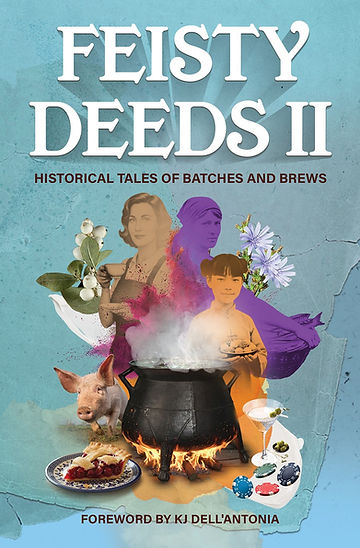
Feisty Deeds II is a fun, yet deeply moving collection of twenty-five stories set in locations all over the world. The unifying theme is food and drink. My short story, “Breadline,” takes place in St. Paul, Minnesota in 1935 and was inspired by my grandmother Mabel Anderson Peterson.
“Breadline” isn’t about Grandma Mabel per se. She plays an important but off-page role working at a Swedish boardinghouse in Waukegan, Illinois. She really did work at a Swedish boardinghouse in Waukegan, but not in 1935. And she lived for a very short time in Minneapolis, not St. Paul.
In 1993, over several dedicated Sunday mornings and endless cups of coffee, a tape recorder propped between us, I interviewed her about her early days. Regarding her time in the Twin Cities, she told me the following. (The words are hers almost exactly, as transcribed from the recording.)
“I graduated from high school in 1927. That fall I went to work in Minneapolis, where Nettie [her sister] was living. Pa bought me a new dress, shoes, coat, and hat and put me on a train in Newfolden [Minnesota]. I didn’t care much for Minneapolis. I saw an ad in the paper for a special on railroad tickets to Waukegan, Illinois. After only a week in the Cities, I bought that ticket to Illinois. Aunt Hilda and Uncles Fred and Tony met me when the train arrived. I stayed with them, got a job, and spent two years in the big city. My first job was at a Swedish boardinghouse. The residents were all Swedes and didn’t speak a word of English. Those were glory days. I had a ball!”

Of course she had a blast; she could speak their language. Her first spoken words were in Swedish. Her father was born in Småland in southern Sweden in 1871. He emigrated to America when he was twenty-one. Her mother was born to Swedish immigrants in Northern Minnesota in 1887. Our red-haired, freckled-faced Baby Mabel was born in 1908, ushered into the world by the steady hands of a Swedish midwife.
I loved listening to Grandma Mabel tell stories about when she was young, and she loved telling them. I can still see the twinkle in her eye when she started to reminisce. I know that sounds cliché, but her eyes really did twinkle! She was one of the most amazing women I’ve ever met. Borrowing at least a small part of her story as a jump-off point in my fiction was an honor and personally very meaningful.
So who, or what, is “Breadline” about?
“Breadline” is the story of Esther and Delores, fictional characters who grew up on farms in Northern Minnesota and in 1935 are trying to earn a living in St. Paul during the Great Depression. They are the product of my imagination, but what happens to them is based on the historical record.
The stock market crash of ’29 had decimated the economy, and along with it, people’s lives. Minnesota was suffering from a serious drought, and gangsters were traveling in and out of St. Paul to and from Chicago on their way to Northern Minnesota’s lakes to hide out. People were starving and relied on breadlines and soup kitchens for food. For a place to live, they sought shelter in flophouses and boardinghouses.
What happens to Delores in the story tragically also really happened to young girls as Minnesota experimented with its own form or eugenics: forced sterilization for the “feeble minded and insane persons,” which mostly meant women “in trouble.” I won’t say more because you know me, I don’t give away spoilers in my reviews.
I wasn’t the only one who was insprired by real a person. Here are five more short stories in Feisty Deeds II that are also biographical in nature.

“Promises and Pie Crusts” by Kimberly Nixon was inspired by her mother’s best friend, Lila, who loved to bake pies. After this grandmother-like woman died, Kimberly discovered Lila had laundered money for the mob in a small Midwestern town during Prohibition and the Depression. Kimberly’s mother used to tell her stories about her childhood years in Applachia, starting a fire in Kimberly to dig into her family’s past. Visit Kimberly Nixons’s website for information about her novels, which feature family secrets.

In “Rice Balls,” a spin-off and expanded short story from writer Apple An’s second historical novel, Daughter of Blue City, An’s story was inspired by her and her sister’s experiences coming-of-age during China’s Cultural Revolution. Born during the Revolution, she emigrated to the States in 1989 and carries in her writing the echoses of history and the resilience of memory. Visit Apple An’s website to learn more about her writing.

In “The Sweetest Burden,” Suzanne Uttaro Samuels bases her story on her great-great-grandmother, Rosina Inglese, who was forced to abandon her infant son to the orphans’ wheel in Sicily during the 1860s Wars of Independence. Rosina is an idealist who believes that after the revolution, she and her lover will reclaim their son, and they’ll live in a Sicily that is free and equal. Rosina is also is a character in Suzanne’s new novel Seeds of the Pomegranate. Visit her website for more on how she uses family history in her writing.

“The Girl from Sermoneta” by Kimberly Sullivan takes place in 1500-1507, primarily in the Papal Palace (today's Vatican) of Rome, Italy. Inspired by one of the most notorious papal families to reside there, the Borgias, Sullivan’s tale imagines what it might have been like for a naïve country girl coming into service for Pope Alessandro VI and her struggles to navigate peril in the Papal Palace. Visit Sullivan’s website for more about her writing.

Patty W. Warren’s “Love Happily After” takes place in Raleigh, North Carolina, in 1969. The main character, Ada, was inspired by her mother and her mother-in-law, two women who loved their husbands deeply and would do anything for them. Both women lost their husbands early in life and were left to carry on without them. Visit her website here.
As you can see from this brief list, the tales in this special anthology are as varied as there are women on earth. I’ve read and sincerely enjoyed every single story.
I hope you'll order a copy of Feisty Deeds II: Historical Tales of Batches and Brews. The book is self-published by members of the historical fiction affinity group of the Women’s Fiction Writers Association and is available in paperback for $11.99 and eBook for just $3.99. (Note: When you visit Amazon, the paperback may temporarily unavailable in the U.S. Check back in a day or two. Hopefully by the time you read this post the paperback is ready for distribution.)
None of the authors profit from the sale of this book. All proceeds go to support the Women’s Fiction Writers Association’s scholarship program, which enables disadvantaged writers to attend WFWA writing conferences and workshops.
If you purchase Feisty Deeds II: Historical Tales of Batches and Brews, please leave a review on Amazon, Goodreads, or BookBub. Reviews help other readers find good books!
You can follow the trail of Feisty Deeds II by signing up for our newsletter, where we’ll keep you posted on feisty happenings, including profiles of our feisty authors and the many other books they’ve written.
In closing, may I encourage you to order a copy of Feisty Deeds II or my novel Solitary Walker: A Novel of Mary Wollstonecraft for the readers on your Christmas list? Books make the perfect present. If you order now, the book will arrive before Christmas. But don’t wait long. Feisty Deeds II and Solitary Walker are print on demand books and take a few days longer to arrive. When you order an eBook, of course, it’s yours immediately.
As always, if you’d like to receive my next review of a biographical novel about a famous woman from the past, be sure to subscribe to my blog and newsletter here or on any page at my website.
Before you go, some important links:
Purchase and review Feisty Deeds II on Amazon
Review Feisty Deeds II on Goodreads
Review Feisty Deeds II on BookBub
Sign up for the Feisty Deeds II newsletter
N.J. Mastro is the author of Solitary Walker: A Novel of Mary Wollstonecraft.


